
When people ask about a pension from SASSA, they almost always mean the Older Persons Grant. It is a monthly social grant for people aged 60 and over, and it is means-tested, which means SASSA checks your income and assets. This guide explains the amount, who qualifies, what to bring, how to apply and what to do if a payment stops.
We checked the facts on 2 November 2026. We are an independent guide, not SASSA, so we cannot see, change or speed up any application.
Is the SASSA pension the same as the old age grant?
Yes. You will see several names for the same grant: Older Persons Grant, old age grant, old age pension and SASSA pension. The Older Persons Grant is the name SASSA uses in its grant lists. It is a social grant paid by SASSA after a means test, not a payout from a retirement fund.
How much is the old age grant in 2026?
The Older Persons Grant is R2,400 a month. That amount took effect in April 2026, after the February 2026 Budget Review announced the increases. The disability and care dependency grants pay the same amount. The war veterans grant is slightly higher, at R2,420.
That answers the common question about the SASSA amount for pensioners. Our grant amounts guide shows every grant in one table and explains the latest increase. If you have questions about how you are paid, see our guide to the SASSA gold card and Postbank.
Who qualifies for the Older Persons Grant?
Two conditions are confirmed in the sources behind this site:
- You are aged 60 or over.
- You pass the means test.
Our sources do not set out the citizenship, residence or other conditions for this grant, and we will not guess at them. Before you apply, ask at a SASSA office or on the toll-free call centre, 0800 60 10 11, whether any other requirements apply to you.
One group needs a special mention. SRD is for people aged 18 to 59, so it stops fitting once you turn 60. If you are on SRD and approaching 60, ask SASSA how to move to this grant. Our SRD eligibility guide explains why age matters for SRD.
How does the means test work?
A means test checks whether your income and assets are low enough for you to need the grant. For the Older Persons Grant, SASSA assesses both, which is why proof of income and assets is a typical document.
SASSA sets the thresholds, and they are not in the sources this site is built on, so we do not print them. You can get the current figures at a SASSA office, on sassa.gov.za or by calling the call centre. Two cautions apply. Figures quoted for SRD do not apply to this grant. And whether a spouse’s income is counted for this grant is something to ask SASSA, because our sources only confirm that rule for SRD.
What documents do you usually need?
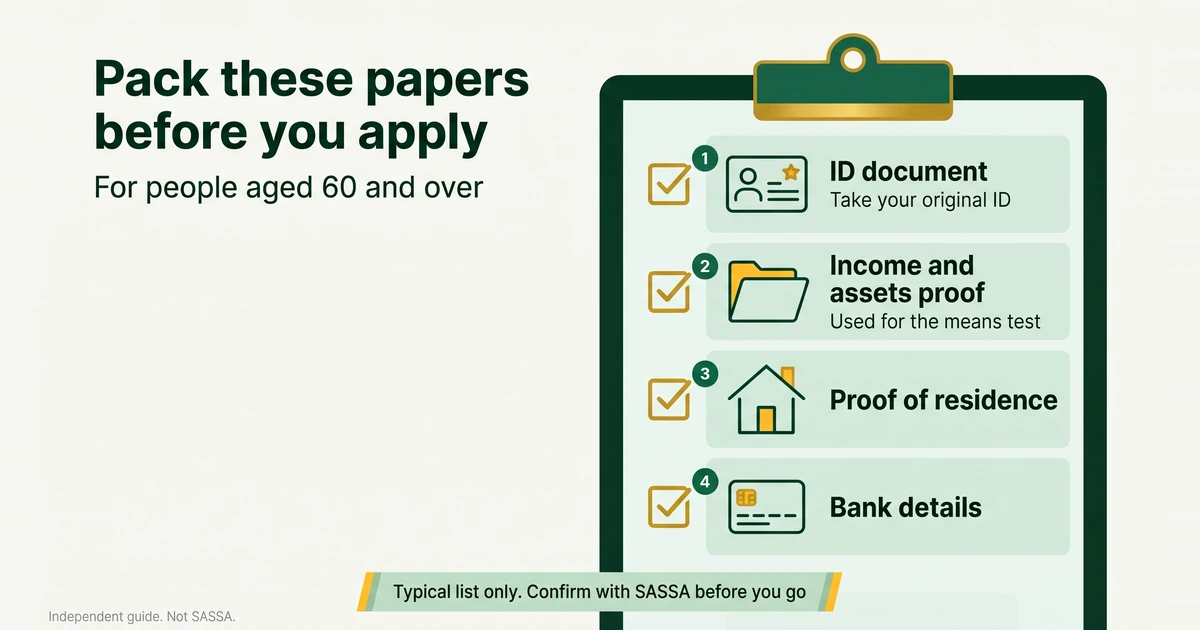
SASSA decides the exact list. These are the documents people are typically asked for, so treat this as a starting point and confirm with SASSA before you go:
- Your ID document. If you go to an office, take your original ID.
- Proof of income and assets.
- Proof of residence.
- Your bank details.
If something is missing, ask SASSA what it will accept instead. Do not hand originals to a “helper”, and do not pay anyone to arrange documents for you.
Where and how do you apply?
Apply in one of two ways:
- At a SASSA office. SASSA’s directory on sassa.gov.za lists the offices. Take your original ID and your documents. SASSA asks beneficiaries not to visit offices unnecessarily, so call first if you are unsure what to bring. Our guide to finding a SASSA office can help.
- On the grant application portal. services.sassa.gov.za is SASSA’s portal for grants other than SRD. We have not captured screenshots of it, so we will not describe its screens. Type the address yourself.
Do not use srd.sassa.gov.za for this grant, because that portal is for SRD only.
A relative or a neighbour you trust can help you use a phone or travel to an office. But never share your PIN or OTP with anyone, and never let anyone keep your ID or bank card.
What happens after you apply?
SASSA assesses your application, including the means test. We have no sourced processing time for this grant, so we will not give one. Keep any receipt, reference number or confirmation, and note the date you applied. Avoid applying twice while you wait. If you want to know where things stand, call SASSA.
When an application is approved, the grant is paid on the older persons date in the schedule. SASSA’s booklet lists “not claimed within 90 days of approval” as a reason a grant can lapse. The booklet is written for social grants in general, so confirm with SASSA how it applies to you, and do not leave a payment unclaimed.
What is worth asking SASSA when you apply?
Our sources leave some practical questions open. Ask them at the office or on 0800 60 10 11, and write down the answers with the date:
- Which documents will you accept as proof of my income, my assets and my address?
- How will my assets be assessed?
- How will I be paid, and what must I do if my bank details change?
- What must I report if my address, my income or my circumstances change?
- How will I be told the outcome, and who do I contact if I hear nothing?
Asking these once, clearly, saves several return trips. It also gives you a record to point to if you later need to explain what you were told.
When is the old age grant paid?
Older persons grants are the first of the three groups paid each month. The table shows the next two months, including the November dates that were revised because of the 4 November local government elections:
| Month | Older persons | Disability | Children’s grants |
|---|---|---|---|
| November 2026 Revised | Friday 30 October | Monday 2 November | Tuesday 3 November |
| December 2026 | 2 December | 3 December | 4 December |
Dates are paid on or after the day shown, and a weekend or public holiday moves a payment to the next working day.
A weekend or public holiday moves a payment to the next working day. For the whole 2026/27 calendar, see the old age grant payment dates guide and the payment schedule.
What should you do if your payment stops or is suspended?
We cannot tell you why a payment has stopped, and our sources do not list reasons, so we will not guess. A wrong guess could send you the wrong way. Work through these steps instead:
- Check the date. Revised months and weekends or public holidays can move a payment, so make sure it is really late.
- Check your statement. Look for the deposit, and ask your bank about the arrival date. We have no sourced timeline for any bank.
- Contact SASSA. Call the toll-free call centre on 0800 60 10 11, which is reported to run in weekday working hours (confirm on sassa.gov.za), or email [email protected]. If you go to an office, take your original ID.
- Ask for the reason. Ask what is recorded against your grant and what you must do next. Write down the date, the name of the person and any reference number.
- Do not wait. If a grant has been unclaimed for a long time, the lapse rule above may matter.
Older Persons Grant or SRD?
| Detail | Older Persons Grant | SRD grant |
|---|---|---|
| Age | 60 and over | 18 to 59 |
| Monthly amount | R2,400 | R370 |
| How to apply | SASSA office or services.sassa.gov.za | Online only, at srd.sassa.gov.za |
| Means test | Yes | Yes, and SASSA reassesses it every month |
| Pay dates | Fixed dates in the schedule | No published fixed pay date |
Other grants worth knowing about
If you are under 60, or you have another need, other grants may fit. The disability grant is for adults with a disability, and our disability grant guide covers it. The grant-in-aid is for people who need a full-time carer and already receive a qualifying grant, and ask SASSA which grants qualify. The SASSA grants overview lists every grant, and our SASSA contact numbers guide lists every official channel.