
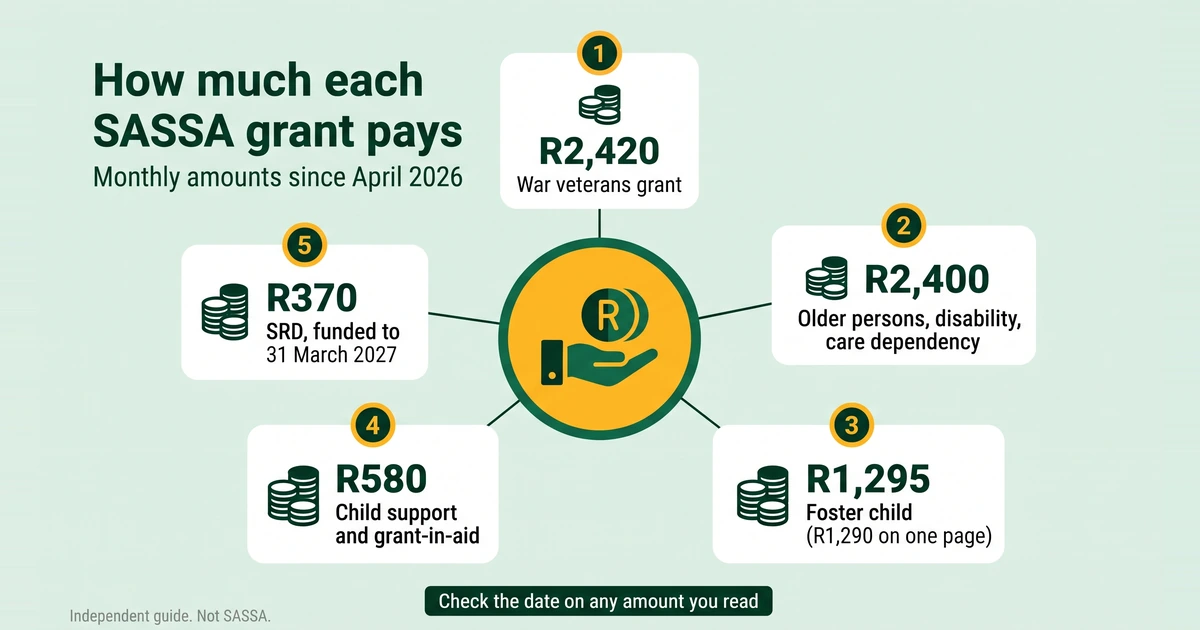
The latest SASSA grant increase took effect in April 2026. The Budget Review announced the new rates on 25 February 2026, and the Department of Social Development confirmed the 2026/27 schedule and increases in March 2026. This page puts every amount in one table, explains the one figure that differs between sources and says what has not changed.
We checked the figures on 2 November 2026 against SAnews, 25 February 2026 and the Department of Social Development announcement. We are an independent guide, not SASSA.
How much is each SASSA grant in 2026?
| Grant | Monthly amount | Who it is for |
|---|---|---|
| Older Persons | R2,400 | People aged 60 and older who pass the means test |
| Disability | R2,400 | Adults with a disability who pass the means test |
| Care Dependency | R2,400 | Parents or carers of a child with a severe disability |
| War Veterans | R2,420 | Qualifying military veterans |
| Foster Child | R1,295 (Budget Review). DSD’s schedule page shows R1,290. | Foster parents of a child placed by a court |
| Child Support | R580 | The main caregiver of a child under 18 |
| Grant-in-Aid | R580 | People who need a full-time carer and already receive a qualifying grant |
| SRD (Social Relief of Distress) | R370 | Adults aged 18 to 59 with little or no income who pass the monthly checks |
Amounts took effect in April 2026. Checked 2 November 2026.
These are monthly amounts. If you are asking how much the new SASSA grant is for a child, there are three answers because there are three child-related grants: the child support grant is R580, the foster child grant is shown at R1,295 and R1,290 (see below), and the care dependency grant is R2,400.
The R580 figure is the published monthly amount for the grant. How it applies when one caregiver looks after more than one child is not something our sources state, so ask SASSA if that is your situation. Our child support grant guide covers who qualifies and how to apply.
The four numbers that matter
A few things stand out. The war veterans grant is R20 above the R2,400 group, which makes it the highest monthly amount. Child support and grant-in-aid share one figure. SRD is the lowest amount and the only one with a funding end date attached. The older persons grant, which many people still call the SASSA pension, has its own guide: see the older persons grant guide.
What changed in April 2026?
SAnews reported on 25 February 2026 that social grants would increase, and the amounts in the table took effect in April. The Department of Social Development’s 2026/27 announcement then confirmed both the increases and the payment schedule.
What we do not do is quote the old amounts or the size of the increase. Neither is in the sources behind this page, and a guessed percentage would be worse than none. If you want to see what changed for you, compare your April 2026 deposit with the March deposit on your bank statement. If your deposit does not match the table, ask SASSA on 0800 60 10 11 or at a SASSA office, and ask your bank for the arrival date, because we have no sourced timeline for any bank.
Foster child grant: R1,295 or R1,290?
Two sources differ by R5. SAnews, reporting on the Budget Review, gave the foster child grant as R1,295. The Department of Social Development’s schedule page shows R1,290. Both were published in 2026, and neither explains the gap.
We show both amounts wherever this grant appears, because we cannot tell from the sources which one is paid. The practical step is to look at what actually arrives in the account of the foster parent and to confirm it with SASSA if the difference matters to you. The foster child grant guide explains the grant in more detail.
SRD: still R370, funded to 31 March 2027
The SRD grant stays at R370 a month. In the Budget Review of 25 February 2026, government set aside an additional R36.4 billion to extend payments to 31 March 2027. That is why you may see “R350” on older pages: the amount later went up to R370, and many people still search for the old figure.
Three cautions apply. First, SRD is reassessed every month, so being approved depends on passing the monthly checks, which are explained in our SRD eligibility and means test guide. Second, the Department of Social Development said in January 2026 that claims the grant is ending are false, but what happens after 31 March 2027 has not been decided. Third, never treat a message that names a new SRD amount as true unless you can find it in a source like SAnews or on sassa.gov.za. Our guide to whether SRD will end in 2027 keeps the confirmed facts apart from rumour.
Which grants pay the most?
From highest to lowest, the monthly amounts are:
- War Veterans: R2,420
- Older Persons, Disability and Care Dependency: R2,400 each
- Foster Child: R1,295 (R1,290 on the Department of Social Development page)
- Child Support and Grant-in-Aid: R580 each
- SRD: R370
Do not choose a grant by its amount. Each one is for a different situation, and SASSA decides who qualifies. The SASSA grants overview explains how to match your situation to a grant.
How can you check any amount you see online?
Grant amounts are copied around social media, and many posts are out of date. Before you trust one:
- Look for a date. An amount with no date may be from before April 2026.
- Look for a named source. Reliable pages name SAnews, the Department of Social Development or sassa.gov.za.
- Compare it with the table above. If it does not match, ask why before you act on it.
- Check the address. SASSA’s web addresses are sassa.gov.za, srd.sassa.gov.za, services.sassa.gov.za and srd.dsd.gov.za. Our official links and scam warning page explains the rest.
- Be careful with screenshots. A forwarded image cannot be checked, so find the original source.
What if the amount you receive looks wrong?
- Make sure you are comparing the right grant. The table shows one grant per row, and every figure is a monthly amount.
- Check the date. November 2026 payments were moved earlier, so a deposit may land sooner than you expect.
- For the foster child grant, compare your deposit with both R1,295 and R1,290.
- Call SASSA on 0800 60 10 11, which is toll-free, or email [email protected]. SASSA asks beneficiaries not to visit offices unnecessarily, so try these first. If you do go to an office, take your original ID.
- Ask your bank for the arrival date and read your statement. We have no sourced timeline for any bank.
How often do grant amounts change?
Grant amounts are usually reviewed around the national Budget, and this year the amounts announced in February took effect in April. Treat that as the usual rhythm, not a promise. Our sources cover 2026 only, so we cannot confirm the pattern for other years, and nothing in them announces any amount for 2027. Check the date on every amount you read, including on this page.
When are the 2026 amounts paid?
The main grants are paid on the dates in the Department of Social Development schedule. November 2026 was revised because of the 4 November local government elections, and December follows the usual pattern:
| Month | Older persons | Disability | Children’s grants |
|---|---|---|---|
| November 2026 Revised | Friday 30 October | Monday 2 November | Tuesday 3 November |
| December 2026 | 2 December | 3 December | 4 December |
Dates are paid on or after the day shown, and a weekend or public holiday moves a payment to the next working day.
Grants under review are paid on Thursday 5 November 2026. A weekend or public holiday moves a payment to the next working day. The whole 2026/27 calendar is in our payment schedule guide, and each grant has its own dates page, for example older persons payment dates and child support payment dates. SRD has no published fixed pay date, so see the SRD payment dates guide for how to read your own.