
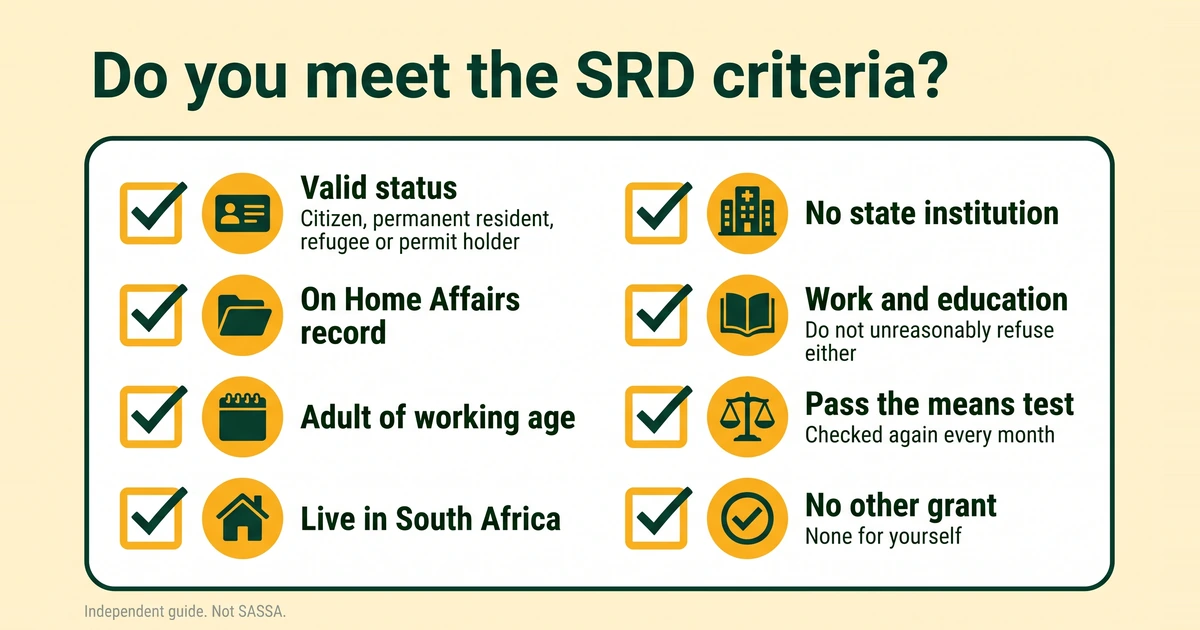
The SRD means test is the check that decides most results. It compares your income, and your spouse’s income if you are married, with a limit set by SASSA, and SASSA repeats the check every month. This guide lists the nine criteria, explains what the means test does and does not tell us, and shows what to do if a decline looks wrong.
The criteria come from SASSA’s 2026 booklet and were last checked on 2 November 2026. We are an independent guide, not SASSA, so only SASSA can decide whether you qualify.
What are the nine SRD criteria?
SASSA’s booklet says a person may qualify if they meet the points below. Meet all of them and you may be approved. Miss one and you will probably be declined, so go through the list honestly.
- Status in South Africa. You are a South African citizen, a permanent resident or a recognised refugee, or you hold a valid special exemption permit (Angolan, Lesotho or Zimbabwe).
- Or asylum-seeker status. You are an asylum seeker with a valid Section 22 permit or visa. Points 1 and 2 are alternatives, so you only need one of them.
- A Home Affairs record. You are registered on the Home Affairs database.
- Age. You are between 18 and 59.
- Residence. You live inside South Africa.
- No state institution. You are not maintained or cared for in a state-funded institution.
- Work and education. You do not unreasonably refuse work or education.
- Means test. You pass it. The next sections explain what that means.
- No other grant. You do not receive another social grant for yourself.
Try the self-check below. It follows the same criteria, it runs in your browser and it never asks for your ID number.
Eligibility self-check
Runs in your browser8 quick questions that follow the criteria in SASSA’s 2026 booklet. It never asks for your ID number, nothing is saved, and only SASSA decides.
How does the means test work?
A means test asks one question: is your income low enough for you to need this grant? For SRD, SASSA looks at your own income and, if you are married, your spouse’s income too.
What makes SRD different from a once-off check is the repetition. SASSA reassesses SRD every month. Our sources add one important detail: in a January 2026 statement, SASSA Mpumalanga said the system can decline an applicant when it finds another source of income, and that it checks external databases, including banks. If money reaches your account regularly, expect it to be visible to that check.
That has three practical effects:
- A result belongs to one month. An approved month does not carry over to the next one.
- Your bank account is part of the picture. Think about what is going into it, not only what you earn.
- Your spouse’s money counts if you are married. It is not enough to say you have no income yourself.
What we do not know is exactly which payments SASSA counts as income and how it weighs them. We have no sourced list, so we will not invent one. If you are unsure whether something counts, ask SASSA first.
R370 is not the income limit
People often mix up two numbers. R370 is what the grant pays each month. The income limit is a different figure, and it is the one the means test uses.
Most sources quote an income limit of R624 a month. SASSA’s 2026 booklet does not state a figure, so confirm it before you rely on it. You can confirm it at a SASSA office, on sassa.gov.za or on the toll-free call centre, 0800 60 10 11.
Two warnings about the number. First, even if your income is below a quoted figure, SASSA can still decline you for another reason, such as another grant or data it finds elsewhere. Second, a limit you read in a social media post may be out of date, so treat it as a starting point only. For the latest grant amounts across all grants, see our grant amounts guide.
Refugees, asylum seekers and permit holders
SASSA’s booklet lists these groups next to citizens and permanent residents:
- Recognised refugees.
- Asylum seekers with a valid Section 22 permit or visa.
- Holders of a valid special exemption permit: the Angolan, Lesotho or Zimbabwe permits.
The word that matters is valid. An expired permit or visa does not meet the criterion, and you must also be registered on the Home Affairs database. The application asks for your citizenship among the personal details, so answer it as it appears on your documents. Permits and visas are dealt with by Home Affairs, not SASSA, so start there if yours is about to expire.
Students, NSFAS and UIF: why declines often mention them
The criteria list does not mention students, and the only education rule is that you do not unreasonably refuse work or education. In practice, though, many declined applicants report seeing a reason that is often shown as NSFAS or UIF.
Treat those labels carefully. They may appear on the portal, but the real wording can differ, so read what your own status card says. The pattern fits what SASSA has said about checking external databases: a match with NSFAS or UIF records can look like another source of income. It does not prove the match is correct. Records can be out of date, for example if your studies ended or your UIF payments stopped.
If the reason looks wrong, keep any letter or statement that shows the date things changed, then appeal that month. The next section explains how.
What disqualifies you from the SRD grant?
Any one of these can end an application:
- Receiving another social grant for yourself. The criterion says “for yourself”, so a child’s grant that you collect as the caregiver is paid for the child. If your situation is unusual, confirm with SASSA.
- Being 60 or older. The Older Persons Grant is the one to look at, and our older persons grant guide covers it.
- Being under 18.
- Living outside South Africa.
- Being maintained or cared for in a state-funded institution.
- Not holding a valid status, or not being on the Home Affairs database.
- Unreasonably refusing work or education.
- Failing the means test.
If none of these fits but you are still declined, the system may have found data you did not expect.
What can you do if you think a decline is wrong?
- Read the result properly. Each month has its own card. Note the month and the reason shown. Our status meanings guide explains each result.
- Check yourself against the nine criteria. Be honest about your account, your spouse’s income and any other grant.
- Fix what is fixable. A referred status is a verification step, not a decline. See what to do when identity verification fails.
- Appeal. SASSA Mpumalanga said in January 2026 that a declined applicant has the right to appeal. You get one appeal per declined month, and you reach the appeals page from the “Lodging an appeal” box on the SRD portal home page. SASSA’s booklet lists the appeals address as srd.dsd.gov.za, and our June 2026 screenshots showed it under srd.sassa.gov.za/appeals, so go in from the official portal. Your screens may look slightly different. Our SRD appeal guide takes you through each step, and the declined-appeal guide covers the most common situation.
- Watch the deadline. Third-party sites quote 90 days. SASSA’s own pages do not state it in this form. Appeal early and confirm with SASSA. Our appeal timing guide explains what is known.
- Consider a fresh application only when needed. Our reapplication guide explains when that makes sense.
Avoidable mistakes before and after you apply
Most people who meet the criteria still lose a month to one of these:
- Letting a permit or visa expire. The criterion says valid, and an expired document does not count.
- Forgetting another grant. If you receive a grant for yourself, SRD will not be paid on top of it.
- Skipping the facial biometric check. New applicants must complete it before approval, and the portal asks people with a referred status to do the same.
- Assuming last month’s result still stands. Because SASSA reassesses SRD every month, check each month’s card.
- Not checking what goes into your account. Income that reaches your bank account can be seen when SASSA checks external databases.
Will the rules change?
SRD is funded to 31 March 2027, and the Department of Social Development said in January 2026 that claims it is ending are false. A permanent replacement has been discussed, but nothing is decided, so we do not describe a design, an amount or a date. Our guide to whether SRD will end in 2027 keeps the confirmed facts apart from rumours.